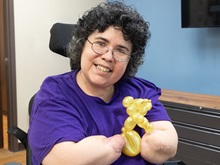
Francis' Story

Amputee Rehabilitation
Francis Zalace’s life was vibrant and full of creativity. A mother of three children, she poured her energy into building a life rooted in joy and service. She was an elementary school music teacher and professional balloon artist, bringing laughter and music to classrooms and community events. She sang in her church choir, volunteered at summer camps and enjoyed culinary adventures with friends in a cooking club. Francis lived fully, until an unexpected illness changed everything.
It began with shortness of breath. Francis went to a nearby urgent care center, but her condition deteriorated rapidly. She was rushed by ambulance to Texas Presbyterian Hospital, where doctors diagnosed pneumonia caused by both bacterial and viral infections. The illness spiraled into sepsis and toxic shock syndrome, life-threatening complications that triggered organ failure and blocked blood flow to her limbs.
“I was unconscious for 10 days,” Francis shared. “When I woke up, my family told me the doctors were recommending amputations to save my life.”
The next four months were spent in the intensive care unit at Medical City Plano’s burn unit. Francis endured more than 20 surgeries to remove damaged tissue. Despite efforts to preserve her limbs, she ultimately became a quad amputee losing both legs above the knee, her left arm below the elbow and her right arm above the wrist.
Additionally, Francis required a tracheostomy for breathing support, a feeding tube for nutrition, dialysis for kidney function and multiple drains and catheters. She couldn’t speak for two months and used a clear letter board to spell words with her eye movements.She also experienced intense disorientation. “My church community took shifts overnight to keep vigil over me for the first two months as I dealt with disorientation and occasional mild hallucinations.”
After months in critical care, Francis transitioned to a long-term acute care facility, then a skilled nursing facility. There, her teams focused on wound care and helping her tolerate sitting upright. To help Francis’ residual limbs heal, skin was taken from her back to graft onto her legs, making sitting up painful and challenging.
Her mother, Carmen, and daughter moved from El Paso to the Dallas area to support her. Carmen advocated for a program that could help Francis regain independence which led them to Baylor Scott & White Institute for Rehabilitation – Dallas.
“When the [clinical] liaison explained the program, we knew it was the right place,” Francis said.
Amputee rehabilitation at Baylor Scott & White involves two admissions. The first focuses on strength and basic mobility; the second on prosthetic training and advanced independence. When Francis arrived for her first stay, she was unable to move in bed or perform any self-care. Her goal was to become strong enough to help her family help her.
“If I could hold my posture and stay stable while they helped me get dressed, it would make it easier for them,” she explained.
Her physician-led team designed a plan combining physical and occupational therapies.
Physical therapy targeted bed mobility, transfers and core strengthening. Francis practiced rolling, leg lifts and exercises on her back, stomach and side. Gradually, she progressed from lying to sitting with minimal assistance.
Caregiver education was a key part of Francis’ plan. “My mom and daughter worked closely with therapists,” Francis said. “They learned how to use the lift, transfer me, care for my wounds and set up my environment for independence.”
By the end of her first stay, Francis could move independently in bed, transfer with minimal help and use a power wheelchair to travel more than 250 feet.
Occupational therapy focused on self-care skills like eating and grooming. Using a modified universal cuff with swivel utensils, Francis learned to feed herself. She practiced hand-to-mouth movements and engaged in range-of-motion exercises to improve upper-body mobility.
In the month she was at Baylor Scott & White Institute for Rehabilitation, she became able to eat and groom herself with set-up assistance. “Every day I felt a little bit stronger,” she said. “I had the confidence to keep trying things on my own.”
Nine months later, Francis returned for her second admission with prosthetic legs. Physical therapy focused on gait training and learning to use bilateral stubbies, short starter prosthetics for early walking. With a forearm walker for stability, Francis practiced moving from sitting to standing. Less than a week into therapy, she stood for the first time in a year and a half, a milestone that filled her and her family with hope. “I can get from a seated position to standing and walk about 100 feet with my walker and stubbies without any assist,” she said proudly.
Occupational therapy introduced adaptive tools for dressing, bathing and hygiene. Francis also continued to refine the use of her forearm-based universal cuff to use standard utensils and a toothbrush independently.
Recreation therapy brought joy back into her life. “[My therapist] was great in getting me to work on my music and balloon art,” Francis said. She was able to play a steel tongue drum using adaptive bands to secure drumsticks to her residual limbs. She also had fun creating balloon art for her occupational and recreation therapists.
Throughout her journey, Francis drew strength from her family and community. Her father stayed by her side while she was unconscious. Her mother and daughter attended therapy sessions and her daughter was by her side every day. Church friends rallied with visits, meals and financial support.
Today, Francis is rebuilding her life with the same creativity, resilience and heart that have always defined her. She recently received her prosthetic arms and is practicing daily, celebrating each new skill. She enjoys dinners and movie nights with her partner and friends, and she continues to inspire former students through her YouTube channel, where she shares updates and answers questions.
Ultimately, she hopes to return to her music classroom. Currently, she works part time with an outreach program that educates students about disabilities through interactive, empathy‑building field trip experiences. There, Francis shares her lived experience to help young people understand mobility differences.
Her message to those students and to others facing similar challenges is: “Define yourself by what you can do, not what you can’t.”