Z's Story

Spinal cord injury
Zecharias “Z” McKinney’s life changed the night he turned 23. On the way home from the birthday gathering, his car collided with another vehicle and slammed into a guardrail. Pinned in his car, he recalled, “I was still conscious, but the door was bent in, so I couldn’t get out of the car and I couldn’t feel my legs.”
Emergency crews extracted Z from the crumbled vehicle and rushed him to Medical City Arlington. Scans revealed a myriad of issues: a fractured sternum, broken ribs, bruised lungs and, most concerning, a spinal fracture. The care team notified Z’s family and he underwent emergency surgery to stabilize and realign pieces of his spine. While the surgery was successful, Z was told he was paralyzed from the waist down. It was overwhelming news.
The Amazon driver’s family was tight and so was his circle of good friends. Many had been over to his new home in Arlington sharing meals, laughs and enjoying time with him and his girlfriend Kanlia. He would need their support now.
“I lost all hope,” he said. “I didn’t think people came back from being completely paralyzed.” His injury was classified as motor complete but sensory incomplete, meaning he had no movement below the level of his spinal injury, but did have sensation, so it was possible that he might regain movement, but how much, if any, wasn’t apparent this soon after the accident.
Z described the days that followed as painful and overwhelming. “I was barely eating, my appetite was down from all the meds,” he said. “They tried to get me to sit up and get out of bed, but nothing worked. I was just hurting too bad.”
Once he was medically stable, Z’s care team suggested specialized spinal cord injury rehabilitation. His mother Pamela, a health care worker, researched the options and chose Baylor Scott & White Institute for Rehabilitation - Dallas.
When he arrived, Z was despondent, unsure how his injury would affect his future. At this point, he couldn’t even move in bed or sit upright without assistance. Part of his immobility was also rooted in the excruciating pain he felt.
Z’s physician-led therapy team at Baylor Scott & White Institute for Rehabilitation was undeterred. Following an assessment, they mapped out a care plan tailored to Z. His physician worked with him to adjust his medication to help ease his pain, allowing him tolerate therapy. Nursing routinely checked his vitals, administered his meds and monitored his comfort level.
The remaining care team then shifted Z’s focus from what he couldn’t do to what he could do and built from there.
Z’s hopes began to lift as his rehabilitation team rallied around him. “[My therapists] were all saying, ‘People do get better, you got this, man!’” he said. He shared his one goal with the care team: to take care of himself independently.
Initially, physical therapy focused on leg and hip stretches to help alleviate pain from muscles and nerves that were damaged. Gradually the work, coupled with a brace to support his lower back and careful medication management, made his pain manageable.
Z worked on bedside exercises, positioning his body to use momentum to complete a roll, sitting unassisted and reaching side-to-side to build muscle and improve balance. He began to work on his core control by sitting at the side of a therapy mat and using his arms to prop himself up, slowly working on letting go with one arm at a time and reaching for objects near his body without losing his sitting balance. He also practiced sitting up from lying in bed and returning to lying to improve his core muscles.
“About the second week, things started to change,” recalled Z. “My [hip] pain got better and then things started to get a whole lot better.”
Occupational therapy taught him to use a transfer board—a short, polished board—that allowed him to slide his body from one surface to another. With it, Z was able to slide his weight from bed to a wheelchair. After three weeks, Z could transfer independently without the transfer board. He worked with his therapists on other transfers. “We reviewed my home bathroom set-up and trialed different shower chairs,” said Z. “We practiced transferring on to the shower chair, off the shower chair, on to a toilet, off the toilet, just lots of practice to get me independent.”
Being able to get in and out of a vehicle was something that Z wanted to master before leaving the hospital. He worked with therapists on car transfers, a challenge because he is 6-feet tall and has long legs. “The first time, it was slow,” he said, “but as we kept doing it, it got better and better.”
He also learned how to be independent in dressing and hygiene. He learned adaptive techniques to dress from bed level, such as best ways to sequence dressing and how to position himself to reduce pain and effort while dressing.
“[My therapist] encouraged me, coached me and gave me a lot of practice,” said Z. “I am now able to manage all my clothing and footwear on my own.”
Recreational therapy played a role in restoring Z’s confidence and making therapy fun. The therapist wanted to help strengthen Z’s body, but more than that, she wanted to let him know that he could still do things that he loved. “My recreational therapist asked me what I would like to do and we agreed to try the hand cycle bike,” said Z. “I have the need for speed,” he joked, “so I was hand cycling and they were chasing me down the parking lot—I felt my muscles working, not hurting—I felt like a new person!”
As time went on, it was becoming evident that Z had some movement in his legs. “They were trying to get me to pick my legs up,” he said. “I started lifting my legs more, I say from there, my legs just started to come back.”
Throughout his rehabilitation, Z’s Pamela and Kanlia were by his side for support and participated in the Care Partner Program. The program educated them on how to care for Z physically and emotionally in preparation for his return home. “I don’t think I’d be able to do this without them,” he said.
After 30-days of inpatient rehab, Z was able to transfer from one surface to another and in out of a vehicle and get dressed independently. “My overall month at Baylor Rehab has been terrific,” said Z. “There are so many kind staff [and] they take such good care of you.”
But Z wasn’t done. He returned home but continued his recovery at Baylor Scott & White’s SCI (spinal cord injury) Max day program—a specialized therapy program in which he participated six hours a day, five days a week. There, his primary goal was to strengthen his legs and work on functional tasks, like cooking, multi-tasking and navigating the community.
Upon starting the Day Neuro Program, Z was examined by a physician who confirmed he had movement in muscles—just enough to enable Z to walk. Once fit with bilateral foot and ankle orthotics to support his legs, the team began expanding Z’s physical therapy activities further strengthening the muscles used for walking.
Z also used a body-weight supported harness and treadmill to continue to build his leg muscles, improve his balance and practice gait training. Aquatic therapy was incorporated and Z enjoyed it. He felt light in the water and used it for resistance training another element that helped strengthen his lower body. The water was fun and relaxing, plus, its buoyancy eased movement and reduced the impact on his joints.
On solid ground, Z’s team fit him with a robotic exoskeleton to help propel leg movement and recapture his natural gait. By mechanically moving his legs, the device helped to reconnect neuropathways in Z’s brain. Those pathways were damaged in the accident, and doing a repetitive action such as walking—even with robotic assistance—can aid in the recovery of motor function.
While the robotic exoskeletons helped tremendously, Z’s biggest moment was when he propelled himself in a walker. Upon arrival at Baylor Scott & White Institute for Rehabilitation, he couldn’t walk and didn’t think it was a possibility. By the time he completed SCI Max, Z could walk up to 150 feet with a walker.
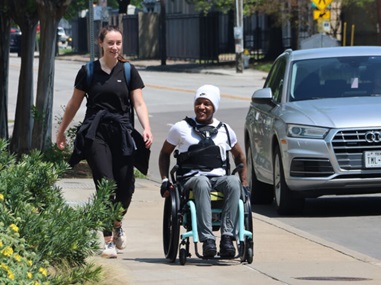
In occupational therapy sessions, Z practiced life’s basic tasks like cooking. He also learned to navigate curbs, ramps and crowds in his wheelchair during community outings to parks and museums. The assorted activities helped Z realize how far he’d come and as his therapists said, things do get better, even though they aren’t the same. Recovery with a spinal cord injury is lifelong and there is a lot to look forward to.
While his newly earned independence, Z is planning to visit the barber and go out for dinner with his family to celebrate.
Z left the hospital with advice to others recovering from a traumatic injury: “There is hope. It’s all about how you approach it … have a positive spirit.”