Articles
Mar 16, 2026
From concussions to strokes: What to know about brain injuries
A high school soccer player jumps for a ball, smacks heads with an opponent and crumbles to the ground.
A middle-aged driver hits another car head-on, his chest slams against the steering wheel and then his body careens violently back into the driver’s seat.
An elderly woman attempts to get out of bed, but her left side won’t work, and her speech is slurred.
Three people in various stages of life. Three different scenarios. All share a common denominator: They have suffered a brain injury.
March is Brain Injury Awareness Month, bringing attention to a condition that affects 2.8 million Americans annually. One in 60 Americans live with a permanent, brain-injury disability.
In its simplest terms, a brain injury occurs when brain cells are damaged or destroyed by internal or external forces. It can range from a mild concussion that resolves within days to a fatal stroke – about as far apart as conditions can be on the same medical spectrum.
So, what is a brain injury? How does it happen? What are the likely outcomes? And is physical therapy a viable treatment option?
Brain injury facts
There are two primary categories:
The first, an impact-related or traumatic brain injury (TBI), is when the brain swells after it’s jostled or twisted, normally due to exterior force.
The second, acquired brain injury (ABI), is triggered internally, often by the formation of a clot that cuts off blood flow and oxygen to the brain or due to a burst vessel that creates bleeding into the brain.
The two most familiar examples of brain injuries are concussions (TBI) and strokes (ABI). However, a recent Brain Injury Association of America poll found 81% of Americans did not recognize a concussion as a traumatic brain injury.
The reasoning is probably twofold: concussions happen so frequently nowadays – roughly one in four Americans has experienced one – due to contact sports, random falls or unexpected collisions that they may be viewed as routine mishaps and not the medical concern they are.
Secondly, most concussions heal on their own without long-term repercussions, perhaps minimizing widespread concern. But those that hang on require treatment, and multiple concussions in a short period of time can lead to serious physiological issues including, in some cases, death.
What’s the concussion plan?
If you think you are experiencing concussion symptoms such as headaches, dizziness, light or noise sensitivity and changes in mood or sleep patterns, you should be examined by a medical professional.
Initial, at-home treatment for a concussion is common-sense based: Don’t overdo it, whether that means resting altogether or taking frequent breaks from concentrating, video screens, movement, bright light, et cetera.
In most cases, if concussion symptoms haven’t improved within two weeks after an incident, they won’t get better on their own. That’s when physical therapy becomes crucial.
Although each case is different, most concussion patients who engage in physical therapy are back to fully functioning within one-to-two months.
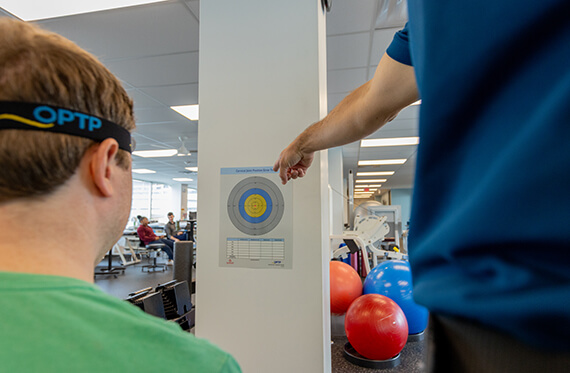
Physical therapy for concussions falls into six physiological regions or domains: cardiovascular/blood flow; neck/orthopedic; eyes/concentration; inner ear/balance; anxiety/behavioral; and sleep/lifestyle management.
The first step of physical therapy for concussions is often cardiovascular treatment to get blood and its nutrients flowing properly, which helps restore the brain’s damaged cells. A patient will be assessed during light exercise, such as walking on a treadmill, and then issued an individualized, cardio-training plan.
Because the neck is involved in the snapping of the head, neck discomfort is often present in concussion cases. Therapists use strengthening, stretching and manual techniques to treat it.
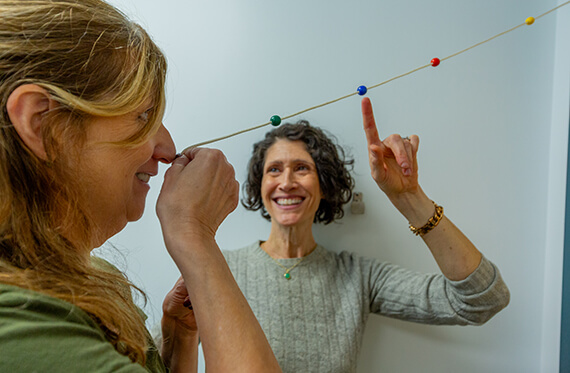
Since messages from the body to the brain are often slowed or disjointed due to a concussion, physical therapy may include simple eye exercises, such as tracking the movement of a pen, as well as inner-ear/vestibular work to improve coordination and balance knocked off-kilter by the injury.

The mental health and sleep management portions involve educational components for patients to use away from centers. Focusing on all six domains help patients recover holistically from what can be both mental and physical trauma.
It’s not just about the head
Surprisingly, concussions are not always caused by blunt impact to the head; sometimes they are caused by exterior force to the torso – such as the above example of the car accident.
Although the head may never collide with the steering wheel, dashboard or back of the car seat, the violent, jerking movement often is enough to cause the brain to be shaken within the skull, stretching nerve fibers while causing swelling. A similar situation can occur during a fall, when the head never hits the ground but the spine, back and shoulders absorb the blow.
Concussions also may occur without the body physically encountering another person or object. Soldiers and heavy-construction workers, for instance, can become concussed simply by being in the vicinity of a high-pressure explosion and its force.
That’s partially why those in concussion protocols, specifically in sports or dangerous occupations, are kept out of contact drills or volatile environments initially. The head may be protected by a helmet or other safety gear, but an impact to the spine or shoulders can cause further damage to a brain that is working through previous swelling.
If the brain is re-injured while it is still in the crisis and recovery stages, the physiological damage can be devastating. Even after the brain appears to be fully healed, its capacity to withstand injury is weakened, which is why once someone sustains a concussion, it becomes more likely for them to be concussed again in the future.
Each time a concussion occurs, the threshold drops, nerve conduction becomes jumbled, the brain becomes more sensitive to injury and, in general, weaker. Therefore, once athletes suffer multiple concussions, it becomes increasingly risky for them to keep playing their sports.
How a stroke is similar but different from a concussion
Although both are brain injuries, the primary difference between strokes and concussions – besides initial cause – is damage occurred.
A concussion is considered a functional injury. Although there may be some structural damage, the primary issue with a concussion is due to brain cells not communicating or functioning properly. With time, physical therapy and the avoidance of another incident, most people will recover completely from a concussion.
It is a different situation with a stroke, which is considered a structural injury. When someone suffers an ischemic (blockage to the brain) or hemorrhagic (bleeding in or around the brain) stroke, brain cells are typically killed, especially the longer the stroke goes untreated.
The brain is the body’s control center, and the more its cells are destroyed, the more everyday function is lost. Even if a stroke does not kill the patient, it often significantly damages a portion of the brain, which can cause paralysis, cognitive disruption and speech difficulties, among other issues.
Those cells destroyed by a stroke typically will not often be restored, so patients must adjust to using the surviving areas of the brain while adapting to different ways of completing tasks that once came naturally, such as walking, lifting an arm or remembering a certain thought. Personalities and temperaments can be altered, causing additional stress for stroke survivors and their loved ones.
Unlike a concussion, where rest is often the first remedy, stroke survivors should immediately seek care at a hospital to be medically stabilized. Their subsequent therapy – physical, occupational and speech-language – typically occurs while at inpatient facilities.
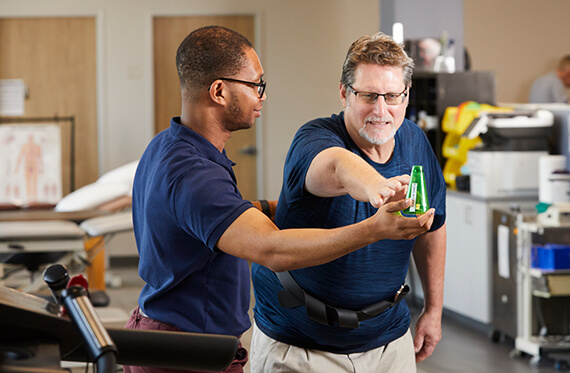
Outpatient therapy for stroke survivors often comes later, when patients are dealing with residual deficits from their original incidents, such as needing assistance with balancing or walking difficulties. Although the affected part of the brain likely won’t be rejuvenated after a stroke, proper therapy can minimize deficits and potentially return stroke survivors to the activities most important to them.
The bottom line
A brain injury, in its definition, sounds serious. And it is.
Some are more debilitating than others. Most times they occur quickly, without warning. And they can happen to anyone anywhere, from a child on an athletic field to a senior citizen walking to the mailbox.
If you (or a loved one) experience a potential brain injury, get it checked immediately. Even if you think it’s just a headache, maybe a mild concussion, it’s important to confirm that and have a plan going forward.
Trained medical experts – including therapists – can help you with that plan.
And help you recover from what typically is a frightening situation.
Clinical contribution to this blog provided by Physical Therapist Emily Fosheim.