Articles
Apr 6, 2026
Occupational therapy: restoring daily life after brain injury
The term “occupational therapy” can be somewhat misleading to the average person. Not to be confused with something that only relates to work, occupational therapy helps people across their lifespan to participate in daily activities they need or want to do such as self-care, working or playing.
April is Occupational Therapy Month and the perfect time to share who occupational therapists are and what they do — taking the mystery out of this specialized area of rehabilitation.
Occupational therapists are highly-trained individuals who focus on the whole person to improve functional independence by:
- Modifying tasks
- Adapting environments
- Teaching new skills
These therapists are habit-builders, goal-setters and innovators who look at a person with injury (fracture, strokes), chronic conditions (arthritis, multiple sclerosis), developmental delays (autism, cerebral palsy) and mental health conditions to regain abilities or restore as much function as possible to enjoy life and living.
It’s important to understand that occupational therapy and physical therapy focus on distinct areas of ability, but often work together to improve quality of life.
While physical therapists focus on the musculoskeletal system to improve mobility, strength and range of motion to target gross motor skills like walking, balance and injury recovery, occupational therapy focuses on meaningful activities of daily living (ADLs) such as dressing, cooking and fine motor tasks to regain independence.
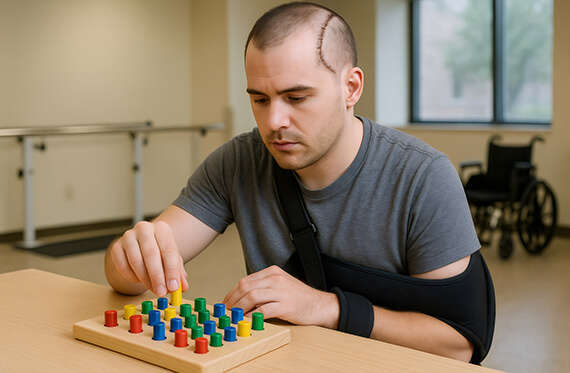
Brain injury as a condition improved by occupational therapy
Any damage to the brain that happens after birth and either temporarily or permanently impairs function falls under the category of brain injury. This particular type of injury can receive healing benefits from occupational therapy and the one-on-one expertise of occupational therapists.
There are two types of brain injury:
- Traumatic brain injury (TBI): Caused by an outside force that affects the head or brain, such as a fall, car crash or assault.
- Concussion, or mild traumatic brain injury: A temporary disturbance in brain function caused by a blow to the head. Loss of consciousness does not always occur.
- Contusion: A bruise on the brain caused by a direct hit to the head.
- Diffuse axonal injury: Damage that occurs when the brain rapidly shifts inside the skull, stretching or tearing nerve fibers.
- Penetrating injury: When an object breaks through the skull and enters the brain.
- Hematoma or hemorrhage: Bleeding in or around the brain that can put pressure on brain tissue.
- Skull fracture: A break in the skull that may injure the brain beneath it.
- Acquired brain injury: Results from medical conditions or illnesses that affect the brain rather than from an external blow.
- Hypoxic or anoxic brain injury: Occurs when the brain does not get enough oxygen, such as during cardiac arrest or near drowning.
- Stroke: Happens when blood flow to part of the brain is blocked or when a blood vessel in the brain breaks.
- Brain tumor: An abnormal growth that can press on brain tissue and interfere with normal brain function.
- Encephalitis or meningitis: Inflammation of the brain or the tissues surrounding it, often caused by infection.
Unique needs of brain injury rehabilitation
The brain serves as the epicenter or communication hub for how the body receives signals for function. Any injury can impact the way the brain operates.
Brain injury can be reflected in:
- Cognitive changes
- Physical changes
- Emotional/behavioral changes
Cognitively, individuals may have memory problems, impairment when it comes to problem solving, issues attention and/or processing information. This is often shown through the ability to complete executive functions or the ability to plan, organize, maintain routines and manage time.
Physically they may see issues with weakness, coordination, balance and increased fatigue.
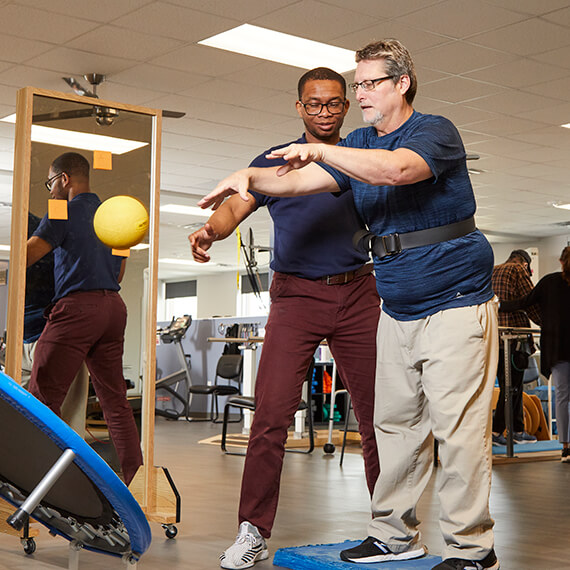
Emotional changes include irritability, anxiety or depression resulting in frustration and impulsivity in actions.
Brain injury individuals experience fatigue — for the normal person, fatigue can be an inconvenience, for those living with brain damage, it can be life-limiting. As the brain works harder to do the tasks it once did flawlessly, a brain-injured person may experience a state of constant weariness, exhaustion or lack of energy that interferes with daily life. Other symptoms include lack of motivation, brain fog and muscle weakness.
Occupational therapy after brain injury
A thorough assessment of abilities and issues impacting everyday life of the patient is where the occupational therapist begins. Getting a full picture involves measurable tests as well as observation and feedback from caregivers.
Understanding who a person is before brain injury as relayed by caregivers, including rituals, passions and hobbies, are a good starting point. Occupational therapists often tie rehabilitation efforts to what someone loved to do before their injury as part of an individualized care plan. This can spark engagement in therapy techniques through desire and motivation to get back to what they loved doing, be that photography, gardening, being active in their community or caring for their pets, as examples.
Visual observation of movement and posture, verbal communication, multitasking skills and comprehension are of value as therapists build a relationship with the patient. While these attributes may not necessarily be measureable in a number sense, they give the occupational therapist the opportunity to prioritize issues needing attention.
Numbers matter too. Observation provides an occupational therapist with a feel of patient needs on a subjective level, while hard numbers, provided by assessment tools, measure improvement or decline objectively by comparing numbers from the same tests throughout the rehabilitation journey. Formal assessment tools use standardized, evidence-based instruments and methods to measure functional performance, cognition, motor skills and sensory processing.
Observation, assessment and patient/caregiver reporting combined directly inform the care plan designed by occupational therapy experts.
Two main approaches in occupational therapy
When it comes to injuries to the brain, severity matters. Brain damage, especially from traumatic brain injury, is classified into three main levels of complexity — mild, moderate and severe. Therapists take classification into consideration as they work with patients on the best care plan for results.
There are two distinct approaches to care, however, it’s not black and white. Therapists may use one of the methods for one issue and the other for a different issue. Realistically, individuals with brain injury can be treated for multiple concerns using a mix of both approaches.
Let’s explore those approaches in more detail.
- Restorative (fix the impairment) – This approach is for any area of function that is identified as something that can be improved through therapy methods. The goal is that over time, patient capabilities will either improve or be restored, tying into the brain’s neurological ability to reorganize its structure, functions and neural connections in response to training, learning and experience.
- Key examples include:
- Therapeutic exercises
- Neuromuscular re-education
- Cognitive rehabilitation
- Sensory integration
- Purposeful activity training, such as practicing dressing to improve range of motion
- Key examples include:
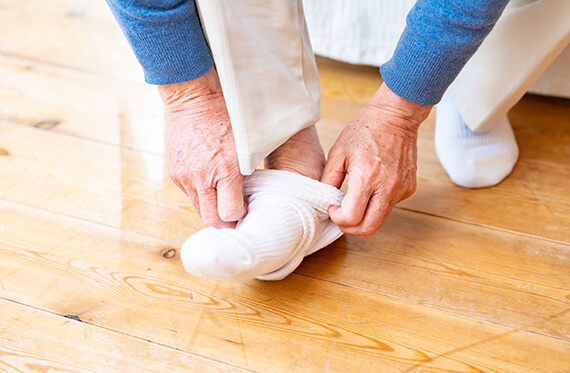
- Compensatory (bypass the impairment) – When function can’t be improved or restored, this approach focuses on teaching strategies that maximize independence by adapting tasks, modifying the environment or using assistive devices to work around permanent limitations.
- Examples include:
- Using assistive technology (e.g., reachers, built-up utensils for enhanced grip and use)
- Modifying environments (e.g., removing rugs for falls prevention)
- Simplifying tasks
- Energy conservation
- Implementing memory aids like calendars or phone alarms
- Examples include:
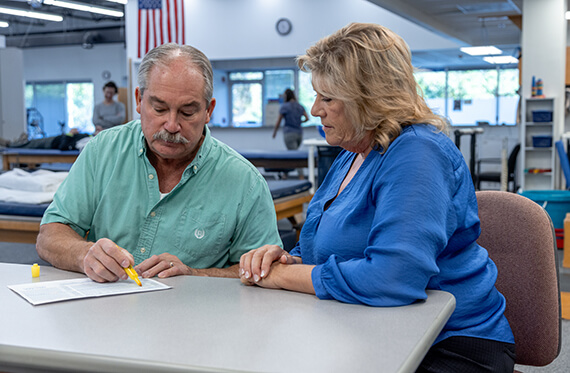
Supporting families and caregivers
The truth is, brain injury impacts more than the injured person. In many cases, residual effects of the injury challenge the patient in their abilities to be independent without the support of a caregiver. For members of a family who suddenly find themselves in a caregiver role, occupational therapy can serve as a guidance system as everyone begins to navigate a new normal.
Occupational therapists do more than just provide therapy, they also educate family members, help them as they navigate the health care system and give them insight into how a brain injured individual processes the world around them.
A common area of struggle is when the person with damage to the brain may appear to be operating normal from the outside, but inside are struggling with issues of fatigue, attention and the ability to process. From the perspective of a person without injury, a caregiver may feel their loved one should be able to accomplish things that, to them, seem simple and feel their loved one is being lazy or not motivated to make progress.
When appropriate, caregivers are often invited to participate in occupational therapy sessions with the patient. This involvement and witnessing of therapy in action gives caregivers the confidence they need to implement activities as home.
With brain injury and recovery, routine becomes very important. The structure of doing things in the same order, on a schedule for things like getting dressed, feeding, toileting and bathing can increase patient participation and ability to be independent which relieves the caregiver of some of the burdens associated with fulltime care.
Changing needs in brain injury
Living with brain injury is a journey patients, caregivers and health care providers travel together. Along the way, destinations of both improvement and decline will be seen. Not a straight path to recovery, an individual with brain damage may arrive needing compensatory treatment only to have a shift in medical status that allows them to suddenly be able to work on repairing or improving an impairment. Or vice versa.
These ever-changing abilities and status changes are a testament to the complexity of issues related to a brain injury. Recovery is often a long process, but is meaningful to both the occupational therapy expert and the patient. Through their work together, people reconnect with activities and roles that give their lives purpose. That purpose could be as powerful as returning to work, driving, engaging in hobbies or as simple as making breakfast for family, painting or gardening.
Occupational therapy and its passionate and trained therapists are focused on more than what the word “occupation” suggests. They are vital in helping people wake up each day, confident in their routine and skills to feel fulfilled in life.
Clinical contribution to this blog provided by Occupational Therapist Julie Lipyanka.